

Where To Get Template Dna
If DNA is a book, then how is information technology read? Learn more about the DNA transcription process, where Dna is converted to RNA, a more portable gear up of instructions for the cell.
The genetic code is frequently referred to as a "design" because it contains the instructions a jail cell requires in order to sustain itself. We now know that there is more to these instructions than simply the sequence of messages in the nucleotide code, all the same. For example, vast amounts of bear witness demonstrate that this lawmaking is the basis for the production of various molecules, including RNA and protein. Research has also shown that the instructions stored within Dna are "read" in 2 steps: transcription and translation. In transcription, a portion of the double-stranded DNA template gives rise to a unmarried-stranded RNA molecule. In some cases, the RNA molecule itself is a "finished product" that serves some important function within the cell. Often, withal, transcription of an RNA molecule is followed by a translation stride, which ultimately results in the production of a protein molecule.
Visualizing Transcription
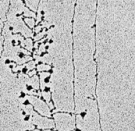
The procedure of transcription can be visualized by electron microscopy (Figure 1); in fact, information technology was beginning observed using this method in 1970. In these early electron micrographs, the DNA molecules appear every bit "trunks," with many RNA "branches" extending out from them. When DNAse and RNAse (enzymes that degrade DNA and RNA, respectively) were added to the molecules, the application of DNAse eliminated the body structures, while the use of RNAse wiped out the branches.
Deoxyribonucleic acid is double-stranded, but only 1 strand serves as a template for transcription at whatsoever given fourth dimension. This template strand is called the noncoding strand. The nontemplate strand is referred to every bit the coding strand because its sequence volition be the same as that of the new RNA molecule. In most organisms, the strand of DNA that serves equally the template for one gene may be the nontemplate strand for other genes inside the aforementioned chromosome.
The Transcription Process
The process of transcription begins when an enzyme called RNA polymerase (RNA politico) attaches to the template DNA strand and begins to catalyze production of complementary RNA. Polymerases are large enzymes composed of approximately a dozen subunits, and when active on Dna, they are also typically complexed with other factors. In many cases, these factors betoken which gene is to exist transcribed.
Three different types of RNA polymerase exist in eukaryotic cells, whereas bacteria have only ane. In eukaryotes, RNA pol I transcribes the genes that encode nearly of the ribosomal RNAs (rRNAs), and RNA political leader III transcribes the genes for ane small rRNA, plus the transfer RNAs that play a key role in the translation process, every bit well every bit other small regulatory RNA molecules. Thus, it is RNA pol II that transcribes the messenger RNAs, which serve as the templates for production of protein molecules.
Transcription Initiation

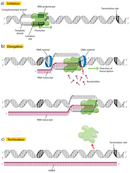
The first step in transcription is initiation, when the RNA politician binds to the Dna upstream (5′) of the gene at a specialized sequence called a promoter (Figure 2a). In leaner, promoters are usually equanimous of three sequence elements, whereas in eukaryotes, at that place are as many as seven elements.
In prokaryotes, most genes have a sequence called the Pribnow box, with the consensus sequence TATAAT positioned most x base pairs away from the site that serves equally the location of transcription initiation. Non all Pribnow boxes accept this exact nucleotide sequence; these nucleotides are simply the most common ones plant at each site. Although substitutions do occur, each box nonetheless resembles this consensus fairly closely. Many genes also accept the consensus sequence TTGCCA at a position 35 bases upstream of the commencement site, and some have what is called an upstream element, which is an A-T rich region 40 to 60 nucleotides upstream that enhances the rate of transcription (Effigy 3). In any case, upon binding, the RNA pol "core enzyme" binds to some other subunit called the sigma subunit to grade a holoezyme capable of unwinding the Deoxyribonucleic acid double helix in club to facilitate access to the factor. The sigma subunit conveys promoter specificity to RNA polymerase; that is, information technology is responsible for telling RNA polymerase where to bind. At that place are a number of different sigma subunits that bind to different promoters and therefore aid in turning genes on and off every bit conditions alter.
Eukaryotic promoters are more complex than their prokaryotic counterparts, in part because eukaryotes have the aforementioned three classes of RNA polymerase that transcribe different sets of genes. Many eukaryotic genes besides possess enhancer sequences, which can be found at considerable distances from the genes they affect. Enhancer sequences control gene activation by binding with activator proteins and altering the 3-D structure of the DNA to assistance "concenter" RNA pol Two, thus regulating transcription. Because eukaryotic DNA is tightly packaged as chromatin, transcription besides requires a number of specialized proteins that assist make the template strand accessible.
In eukaryotes, the "core" promoter for a factor transcribed by politician II is virtually often found immediately upstream (5′) of the commencement site of the factor. Most political leader II genes take a TATA box (consensus sequence TATTAA) 25 to 35 bases upstream of the initiation site, which affects the transcription charge per unit and determines location of the start site. Eukaryotic RNA polymerases utilise a number of essential cofactors (collectively called general transcription factors), and 1 of these, TFIID, recognizes the TATA box and ensures that the correct outset site is used. Another cofactor, TFIIB, recognizes a different common consensus sequence, G/C G/C G/C Yard C C C, approximately 38 to 32 bases upstream (Effigy 4).
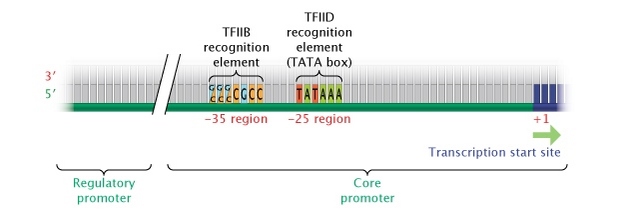
Figure four: Eukaryotic cadre promoter region.
In eukaryotes, genes transcribed into RNA transcripts by the enzyme RNA polymerase Two are controlled by a cadre promoter. A core promoter consists of a transcription commencement site, a TATA box (at the -25 region), and a TFIIB recognition element (at the -35 region).
© 2014 Nature Education Adapted from Pierce, Benjamin. Genetics: A Conceptual Approach, 2nd ed. All rights reserved. 
The terms "stiff" and "weak" are often used to depict promoters and enhancers, co-ordinate to their effects on transcription rates and thereby on cistron expression. Alteration of promoter strength can accept deleterious effects upon a prison cell, often resulting in illness. For example, some tumor-promoting viruses transform healthy cells by inserting strong promoters in the vicinity of growth-stimulating genes, while translocations in some cancer cells identify genes that should be "turned off" in the proximity of stiff promoters or enhancers.
Enhancer sequences do what their proper noun suggests: They act to enhance the rate at which genes are transcribed, and their effects can be quite powerful. Enhancers can exist thousands of nucleotides away from the promoters with which they interact, but they are brought into proximity by the looping of DNA. This looping is the event of interactions between the proteins leap to the enhancer and those bound to the promoter. The proteins that facilitate this looping are called activators, while those that inhibit information technology are called repressors.
Transcription of eukaryotic genes by polymerases I and Iii is initiated in a similar style, only the promoter sequences and transcriptional activator proteins vary.
Strand Elongation
Once transcription is initiated, the Deoxyribonucleic acid double helix unwinds and RNA polymerase reads the template strand, calculation nucleotides to the iii′ stop of the growing chain (Figure 2b). At a temperature of 37 degrees Celsius, new nucleotides are added at an estimated rate of about 42-54 nucleotides per second in bacteria (Dennis & Bremer, 1974), while eukaryotes proceed at a much slower pace of approximately 22-25 nucleotides per 2nd (Izban & Luse, 1992).
Transcription Termination
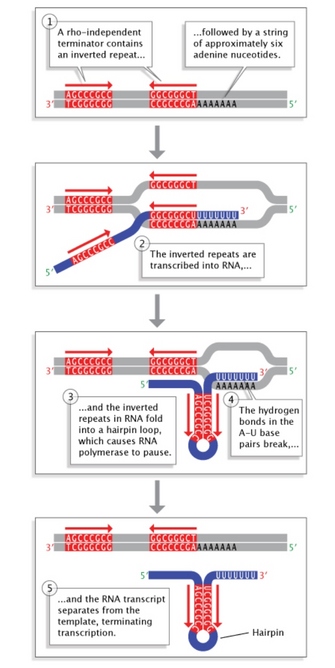
Figure five: Rho-independent termination in leaner.
Inverted repeat sequences at the end of a gene allow folding of the newly transcribed RNA sequence into a hairpin loop. This terminates transcription and stimulates release of the mRNA strand from the transcription machinery.
© 2014 Nature Education Adjusted from Pierce, Benjamin. Genetics: A Conceptual Approach, 2d ed. All rights reserved.
Terminator sequences are found close to the ends of noncoding sequences (Effigy 2c). Bacteria possess two types of these sequences. In rho-contained terminators, inverted repeat sequences are transcribed; they can and then fold back on themselves in hairpin loops, causing RNA pol to pause and resulting in release of the transcript (Figure 5). On the other hand, rho-dependent terminators make use of a factor called rho, which actively unwinds the Dna-RNA hybrid formed during transcription, thereby releasing the newly synthesized RNA.
In eukaryotes, termination of transcription occurs by different processes, depending upon the exact polymerase utilized. For pol I genes, transcription is stopped using a termination factor, through a machinery similar to rho-dependent termination in leaner. Transcription of politician Iii genes ends after transcribing a termination sequence that includes a polyuracil stretch, by a mechanism resembling rho-independent prokaryotic termination. Termination of pol II transcripts, however, is more complex.
Transcription of politico 2 genes tin can continue for hundreds or even thousands of nucleotides beyond the end of a noncoding sequence. The RNA strand is then cleaved by a circuitous that appears to associate with the polymerase. Cleavage seems to be coupled with termination of transcription and occurs at a consensus sequence. Mature pol 2 mRNAs are polyadenylated at the iii′-stop, resulting in a poly(A) tail; this process follows cleavage and is also coordinated with termination.
Both polyadenylation and termination make use of the same consensus sequence, and the interdependence of the processes was demonstrated in the late 1980s by work from several groups. I group of scientists working with mouse globin genes showed that introducing mutations into the consensus sequence AATAAA, known to be necessary for poly(A) addition, inhibited both polyadenylation and transcription termination. They measured the extent of termination by hybridizing transcripts with the unlike poly(A) consensus sequence mutants with wild-blazon transcripts, and they were able to encounter a decrease in the signal of hybridization, suggesting that proper termination was inhibited. They therefore ended that polyadenylation was necessary for termination (Logan et. al., 1987). Another group obtained similar results using a monkey viral system, SV40 (simian virus 40). They introduced mutations into a poly(A) site, which caused mRNAs to accrue to levels far above wild type (Connelly & Manley, 1988).
The exact relationship between cleavage and termination remains to be determined. I model supposes that cleavage itself triggers termination; another proposes that polymerase action is affected when passing through the consensus sequence at the cleavage site, possibly through changes in associated transcriptional activation factors. Thus, enquiry in the surface area of prokaryotic and eukaryotic transcription is withal focused on unraveling the molecular details of this complex process, information that will allow us to better empathise how genes are transcribed and silenced.
References and Recommended Reading
Connelly, South., & Manley, J. L. A functional mRNA polyadenylation betoken is required for transcription termination by RNA polymerase 2. Genes and Development iv, 440–452 (1988)
Dennis, P. P., & Bremer, H. Differential charge per unit of ribosomal protein synthesis in Escherichia coli B/r. Journal of Molecular Biology 84, 407–422 (1974)
Dragon. F., et al. A big nucleolar U3 ribonucleoprotein required for 18S ribosomal RNA biogenesis. Nature 417, 967–970 (2002) doi:10.1038/nature00769 (link to article)
Izban, M. G., & Luse, D. Due south. Gene-stimulated RNA polymerase II transcribes at physiological elongation rates on naked DNA only very poorly on chromatin templates. Journal of Biological Chemistry 267, 13647–13655 (1992)
Kritikou, E. Transcription elongation and termination: It ain't over until the polymerase falls off. Nature Milestones in Gene Expression 8 (2005)
Lee, J. Y., Park, J. Y., & Tian, B. Identification of mRNA polyadenylation sites in genomes using cDNA sequences, expressed sequence tags, and trace. Methods in Molecular Biological science 419, 23–37 (2008)
Logan, J., et al. A poly(A) improver site and a downstream termination region are required for efficient abeyance of transcription by RNA polymerase Ii in the mouse beta maj-globin cistron. Proceedings of the National Academy of Sciences 23, 8306–8310 (1987)
Nabavi, South., & Nazar, R. N. Nonpolyadenylated RNA polymerase Ii termination is induced by transcript cleavage. Journal of Biological Chemistry 283, 13601–13610 (2008)

Where To Get Template Dna,
Source: https://www.nature.com/scitable/topicpage/dna-transcription-426/
Posted by: burnsanin1939.blogspot.com
0 Response to "Where To Get Template Dna"
Post a Comment