

How To Use Guide Lines For Drawing
Last Updated on Nov 24, 2022
Observational drawing is an integral component of many loftier schoolhouse Art courses, including GCSE/IGCSE and A Level Art. Often, cartoon is the cadre method of researching, investigating, developing and communicating ideas. While it is accustomed that at that place are many wondrous types of drawings – and that non-representational cartoon methods have an important function in educatee Art projects – it is usually advantageous to demonstrate competent, realistic observational drawing skills to the examiner (especially in the early phase of a projection).
What follows is a list of tips that have been written specifically for high school art students who are looking to improve the realism of their observational drawings. Information technology is for those who have already selected something advisable to draw (see this guide for selecting subject matter if you lot need help with this) and who empathise how to etch a cartoon well (this will be covered in a subsequent article).

Tip 1: Look at what yous are drawing

Failing to wait at what yous are cartoon is one of the nigh primal errors an Art pupil can make
This sounds obvious, but it is the most common fault made by art students. Many students attempt to depict things the way that they think they should look, rather than the fashion they actually do await.
The but style to record shape, proportion and particular accurately is to look at the source of data. Human memory does not suffice. Forms, shadows and details are difficult enough to replicate when they are right there in front end of you; if you take to make them up, they announced even less convincing. In order to produce an outstanding observational drawing, you must find: your eyes must continually trip the light fantastic from the piece of paper to the object and back again. Not just once or twice, but constantly.
Note: even if you pursue a theme about mythical creatures, fairy tales or some other imaginary form, y'all should work as much as possible from ascertainment. Piece your creatures together from fragments of life. Wearing apparel people up and and then describe them or merge dissimilar parts of insects or creatures together (using artistic license as appropriate) rather than creating an unabridged form or scene from your caput.
Tip 2: Draw from existent objects whenever possible

The phrase 'observational drawing' typically implies cartoon from life (see the superb observational drawing exercise set by creative person and teacher Julie Douglas). Inquire any art teacher and they will listing the benefits of drawing from objects that are sitting directly in front of you. Y'all are provided with a wealth of visual data…changing light conditions; rich textures; views of the subject from alternate angles; as well as information from other sense…smells and noise from the environs etc. Transcribing from three-dimensions to two is ultimately much harder than drawing from a photograph, but it frequently results in drawings that are 'richer' and more authentic.
(This doesn't hateful, withal, that you should never draw from photographs. Students frequently traipse from habitation to school and back again: it can exist impractical to carry and prepare up circuitous still life arrangements over and over over again. Some subjects – such as landscapes and nude models – are too unavailable in nearly classroom settings. It tin therefore be good practise to set up a still life organization in the mankind (or visit a location) and begin cartoon straight from the discipline, using photographs to complete the piece of work at abode).
Tip 3: Don't trace
Throughout history, great realist painters have traced from photographs or worked from projections diddled upward onto walls. But these painters are not high school art students; nor are they assessed on their ability to replicate form.
There is a place for tracing in IGCSE or A Level Art (such as when tracing over something you have already drawn or creating a repeat pattern), but tracing from photographs and and then simply applying colour or tone is not acceptable. Such methods of 'drawing' involve minimal skill, teach you little and run the risk of producing clunky, soul-less outlines. Don't do it.
Tip iv: Empathize perspective
As objects get further away they appear smaller. The replication of this change of calibration on paper (through the use of vanishing points) is called 'perspective'. The fundamentals of perspective are normally taught in junior high school; by Yr 10 at the latest. If y'all are a senior art educatee and have somehow missed this lesson, remedy this situation urgently. At that place are not many theoretical aspects of art that are essential to learn, but this is i of them. Please view the perspective handouts in the Student Art Guide gratuitous teacher resource to get you started.
Tip 5. Use grids, guidelines or crude forms to get the proportions right before yous add together details
Many students start with a tiny item (the centre on a face, for case) and so gradually add in the rest of the image…ending up with a drawing that is badly proportioned or doesn't fit on the page (or floats aimlessly in the middle of it). This can exist avoided by approximating the bones forms before calculation details or by using guidelines to ensure that proportions are correct.
If working from a photo, using a grid tin can issue in highly accurate work. It allows students to focus on one small segment of the epitome at a time and gives arbitrary lines from which distances tin exist gauged. This can exist a helpful strategy when precise, detailed images are required and can itself get a celebrated component in an artwork. Equally gridding is methodical and involves meticulous plotting of lines, notwithstanding, it is of import to acknowledge that this arroyo runs the chance of producing tight and regimented drawings that lack in 'spirit' and should thus be approached with care.
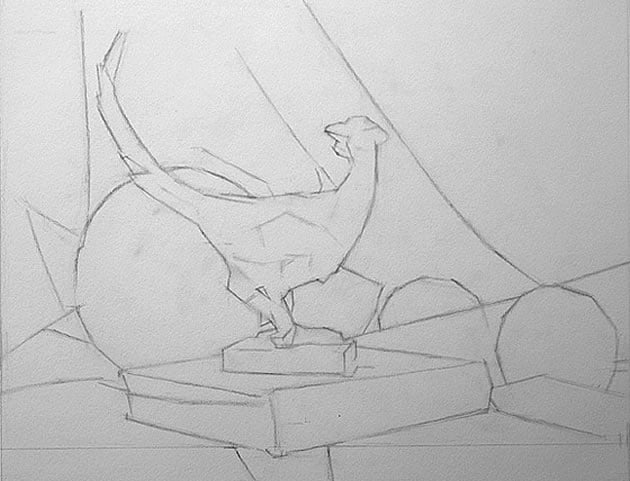
If working from life, roughly sketching outlines of the major forms volition permit you to get the proportions right, earlier you lot add the details. While y'all exercise this, you lot should constantly check which points line upward (i.due east. edge of nostrils lining up with edge of eye) and the size of every object should be estimated in relation to the things that are beside information technology. Y'all must get used to seeing things non in terms of absolute scale, simply in terms of how one thing compares to some other.
An initial observational cartoon past artist Douglas Flynt:
Tip 6: Be wary of ellipses
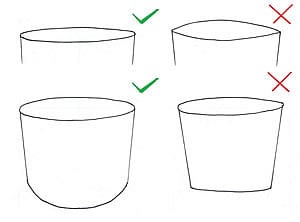
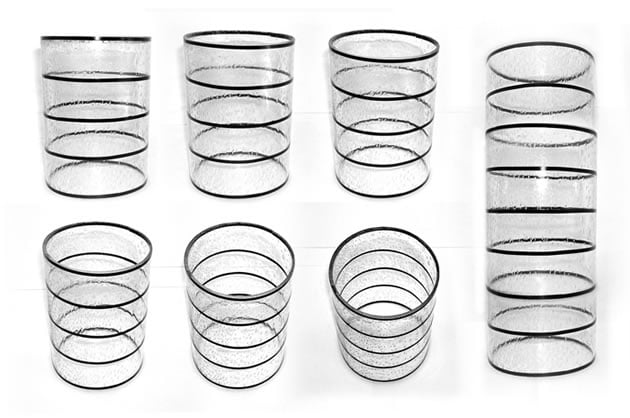
Ellipses – the oval shapes that are visible at the height of cylindrical objects such as bottles or jars – frequently 'trip up' a weak drawer . They can transport an firsthand betoken that a student isnot looking at what they are drawing. All ellipses, no matter what angle they are viewed from, should be rounded (not pointed) at the ends, every bit illustrated in the epitome to the left (pastRachel Shirley) and below (sourced from IDsketching).
Tip 7: Keep the outlines low-cal

Every bit your cartoon is fleshed out in more detail, with attention given to the subtle variations in shape and form, the natural inclination – especially of the novice drawer – is to want to darken in the outlines, to aid ensure they are visible. Practise non exercise this.
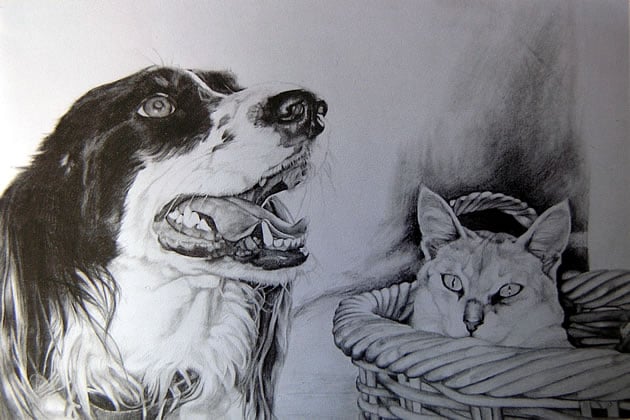
Real objects do not have dark lines running around every edge. Edges should instead exist defined by a change in tone and/or colour, every bit in the cute graphite drawing by an IGCSE Art student shown to the left.
If you are producing a line drawing, a cartoon or some other graphic image, outlines may be darkened, just in an observational drawing – particularly one which you lot wish to be realistic – nighttime outlines are never advised.
Tip viii: Have a Good Range of Tone
When information technology comes to applying tone to your drawing, as with everything else, look at the object. Notice where the light and nighttime areas are and copy what you meet. In virtually all cases, your cartoon should have a full range of tone, from black, through a multitude of greys (or coloured mid-tones) through to white.
Some students – having learnt how to blend tone smoothly from dark to lite – develop the unfortunate habit of randomly shading all surfaces from nighttime to light. Tone should never exist invented and it should never be applied by guesswork.
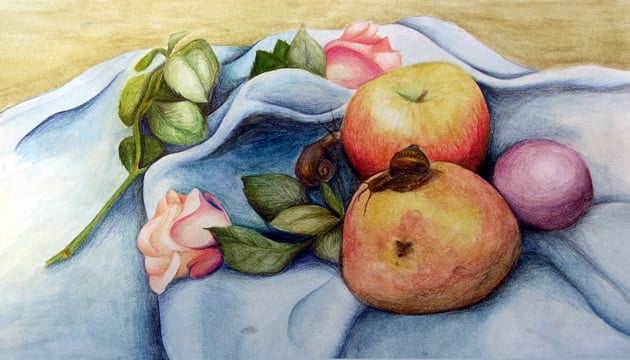
Tip 9: Use marking-making to convey surface quality and texture
When producing an observational drawing, the marker-making used should help to convey the texture(s) of the subject field matter. There are a multitude of unlike ways a pencil tin strike paper – hatching / dashes / smudges / dots… call back carefully before you decide which technique to use.
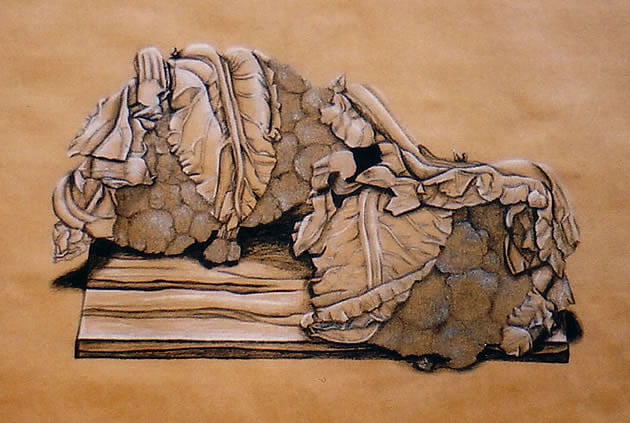
Tip 10: Include / omit item as necessary
One area where students frequently become disheartened is in the depiction of incredibly circuitous subjects. When cartoon trees, plants and bushes, it is not necessary to replicate every leaf or stick. When cartoon a person, it is non necessary to depict every strand of hair. The artist is e'er in a position to pick and choose what goes in their artwork. As long every bit the decision is based on what is aesthetically best for the work (rather than wanting to leave out something that is hard to draw…which is often the driving strength behind students wanting to eliminate certain aspects of their image) there is nothing wrong with omitting certain details from a drawing. In fact, ofttimes the composition is less chaotic and easy on the heart because of it.
At that place are many approaches to this. Sometimes every single detail might be recorded with accuracy. Sometimes a sure expanse of a cartoon is rendered in full, with other parts trailing away.

Tip xi: Insert your own soul
Near of the tips above are aimed at helping a pupil create more realistic observational drawings. This last tip is something different. It is a reminder that sometimes information technology is the divergence between the real item and the cartoon that matters.
Although observational drawings are usually expected to be realistic in nature, they do non need to exist hyper-realistic (in other words, they don't take to look exactly like a photo). Often, information technology is the unrealistic parts: the unexpected marker-making – the gap between the real object and what is drawn – where the soul sneaks in. It is the dazzler in smudges and irregularities and artistic interpretation. Even an IGCSE or A Level Fine art student is an artist. Embrace this!
A beautiful graphite drawing past April Coppini:

If you enjoyed this article, you may also like read the Student Art Guide series about artistic employ of media, which provides tips and advice for students who are wishing to make their drawings, paintings or sketchbook presentation more than exciting.

Amiria has been an Art & Design teacher and a Curriculum Co-ordinator for seven years, responsible for the course blueprint and assessment of pupil work in two high-achieving Auckland schools. She has a Available of Architectural Studies, Bachelor of Compages (Start Grade Honours) and a Graduate Diploma of Education. Amiria is a CIE Accredited Fine art & Design Coursework Assessor.

Source: https://www.studentartguide.com/articles/realistic-observational-drawings
Posted by: burnsanin1939.blogspot.com
0 Response to "How To Use Guide Lines For Drawing"
Post a Comment